INITIALISE at EuroBioC 2026: Exploring links between microbial metabolism and infant temperament
Research supported by the INITIALISE project was presented at the European Bioconductor Conference, EuroBioC 2026, held in Turku, Finland.
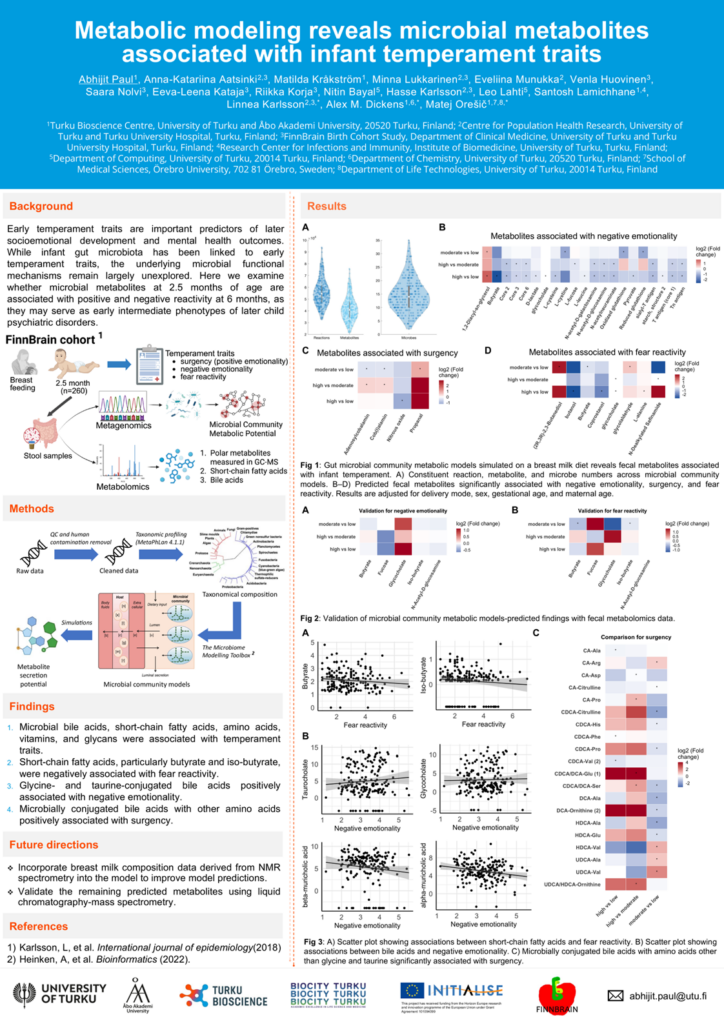
Abhijit Paul, researcher from the University of Turku presented a poster titled “Metabolic modeling reveals microbial metabolites associated with infant temperament traits.
Early temperament traits can provide important indications of later socioemotional development and mental health outcomes. Although the infant gut microbiota has previously been linked with temperament, the microbial functions behind these associations remain largely unexplored.
Using data from 260 infants participating in the FinnBrain cohort, the study examined whether microbial metabolites at 2.5 months of age were associated with temperament traits measured at six months. The researchers combined metagenomics and metabolomics with microbial community metabolic modelling. The models estimated which metabolites the infants’ gut microbial communities could produce when simulated on a breast milk diet.
The analysis focused on surgency, described in the poster as positive emotionality, as well as negative emotionality and fear reactivity.
The results identified associations between these temperament traits and several groups of microbial metabolites, including bile acids, short-chain fatty acids, amino acids, vitamins and glycans.
In particular, the study found that:
- Butyrate and isobutyrate were negatively associated with fear reactivity.
- Glycine- and taurine-conjugated bile acids were positively associated with negative emotionality.
- Microbially conjugated bile acids involving other amino acids were positively associated with surgency.
The researchers also compared findings predicted by the microbial community metabolic models with metabolites measured in faecal samples.
The next steps include incorporating breast milk composition data into the models to improve their predictions and validating the remaining predicted metabolites using liquid chromatography–mass spectrometry.
The full poster, including the study methods, figures and results, is available below.